Saturday, May 19, 2012

Blog #12


I did not have my focus class critique members' artworks. I had them VTS artwork from another kindergarten class. I made that decision because they are up and around talking about their pictures with their peers when they are making art. I felt that they might have given away the meaning of the pictures.

The strength of VTSing peer artwork with this age group is that they have no bias. Everything they VTS carries equal weight. Another strength is that they are looking at artworks that they themselves could easily make, and they move through the pictorial space fluidly. Lastly, having your artwork put up at this age is a big deal.

The weakness to using VTS as a peer critique with this group of kindergartners is that they talk about what they are making and what it means. Which is awesome, I guess. It would be neat if adults had the ability to communicate purpose and meaning so freely. But I think it might create viewer bias when interpreting it. I also need to find out if the kindergartners would feel the need to correct what others are saying about their work.

The students approached these images as they do with any VTS critique. I was personally curious to see if the students would read the artworks close to the artists intended meaning. I think they got the surface readings, but not the idiosyncrasies or layers of details that built into the original narratives.

I would use this approach if I were asking students to make revisions to their artwork.

I need to note that there were some side conversations going on about the images as we were VTSing. I didn't redirect the talking students because they were talking about the art, not messing around.


Peer Review Preface

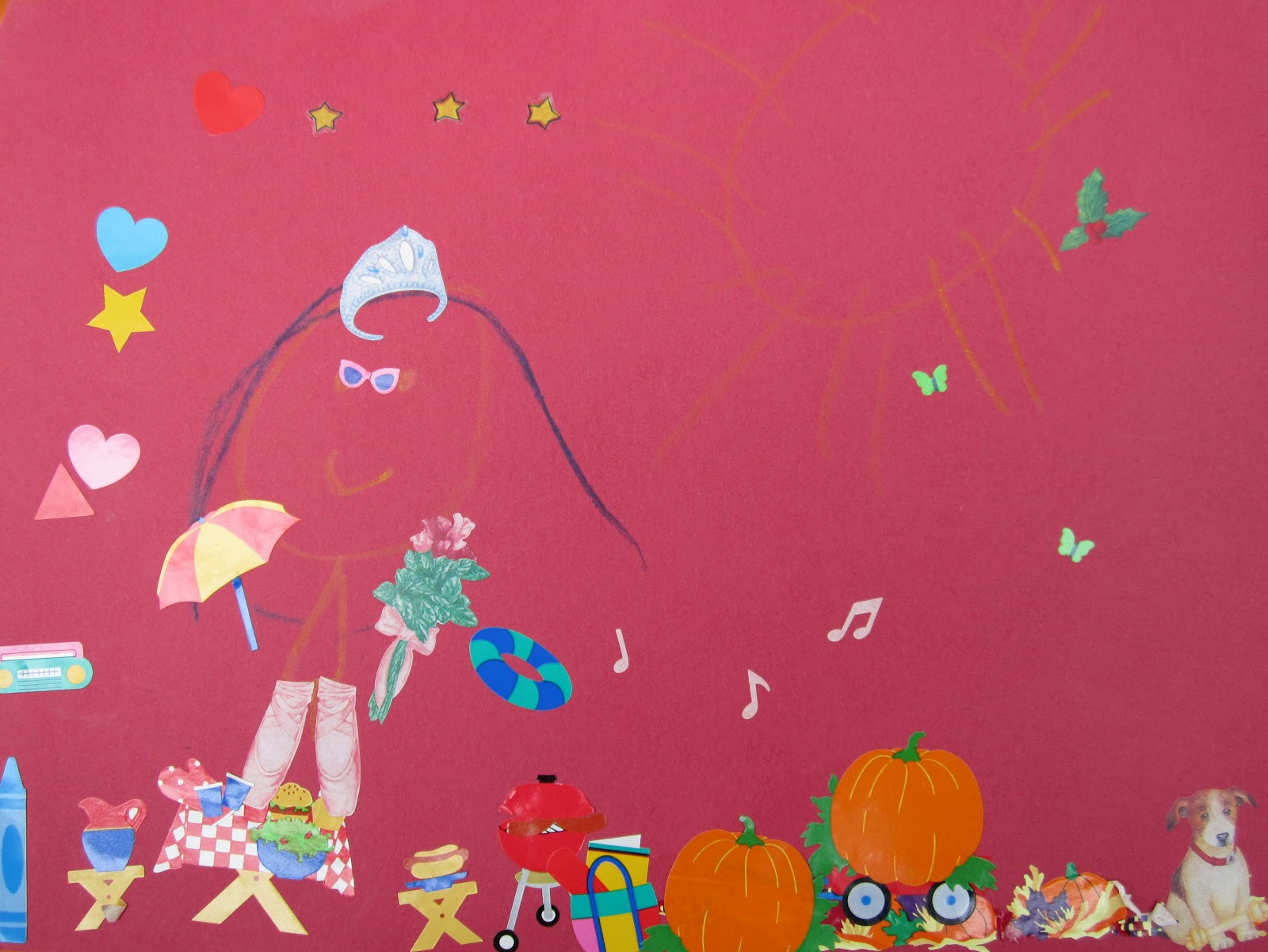
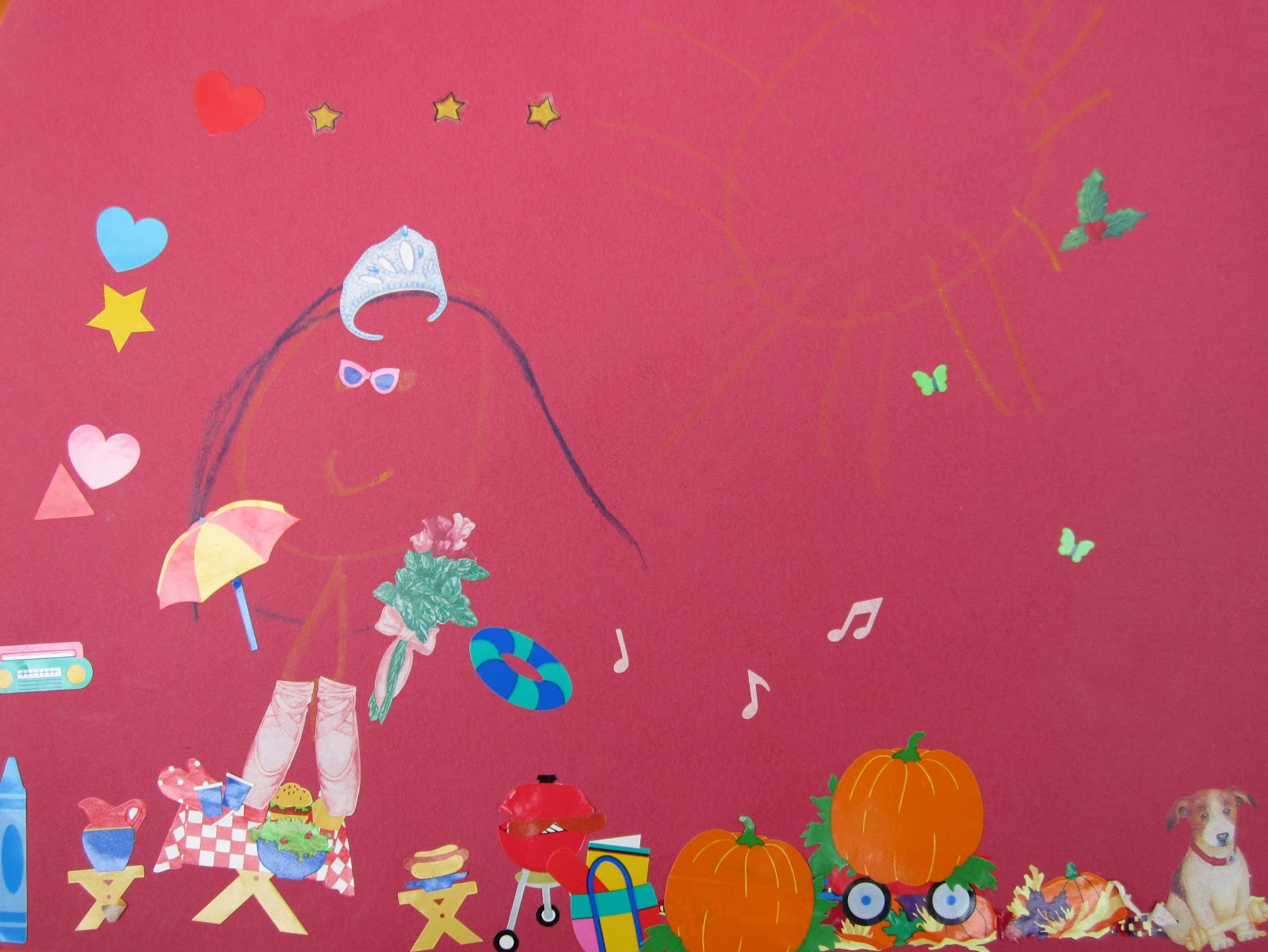
I was worried about the peer review assignment. My kinders work is pretty much teacher centered. My first idea was to have the students peer review a class mural made after viewing the final image. But the murals the classes made were not readable from a distance - the crayon on the butcher paper didn't really pop out. I am in the process of packing up my room, so I put out a whole bunch of stickers, scraps of construction paper, and crayons. I asked Thursday's kinder classes to make sticker pictures - a combination of stickers and drawing - while I packed up my paints.  At the end of classes I noticed that quite a few students had created narratives. The stronger narratives are included here. I interviewed four students after classes, asking the students to tell me about their drawings, prompting them VTS style if they seemed to get stuck. The following are loose transcripts. I am having my focus group VTS a few of these images Wednesday. I am interested  to see if they interpret the images close to the artists' intents.

*****I really liked the use of stickers. The stickers complimented their natural idiosyncrasies and creativity. They were also a representational tool for the young artists who can't draw well yet.

Identifying information has been omitted from images and text.


Image 1
(Points to hat). That makes all that stuff come out and turned me into a monster. (Points to figure). (Points to green and blue sticker). That is a roller coaster. (Points to cube with holes). A vacuum comes out of the holes and sucks up all the stuff and I become myself again.


Image 2
I am eating. Then I go swimming. There is a carnival (points to autumn stickers). After I finish eating I go swimming then come eat. (Points to musical notes) I heard somebody singing.


Image 3
(Points to the biggest picture.) I am in a band. I have a mohawk. The band is the Rockin' Devils. (Points to the figure in the background.) That's _______. He shaved his hair except for a little bit. It is a kind of mohawk. (Points to stickers on the right hand side.) That is all the stuff they need. (Points to the candy corn.) That is the devil's food. (Points to the "BOO!" sticker.) The devil is trying to scare people away. (Points to jack o lantern with the hat). That is the devil's hat and face because they chopped it off. Then they put the words in my mouth. Then I started saying it (points to the "BOO!" sticker.) (Points to figure in background). Those are drumsticks to hit these (points to cymbals and makes a tinny sound). Then he hits this (points to drum and says "boom, boom.") We are the Rockin' Devils. (Points to figure in foreground and mimics the facial expression). He looks that way because he is a rock star. (Points to pumpkin sticker again, and changes the meaning of the sticker, because his friend is listening and asks "Where am I?") ______ is watching us play. He is cheering us on.


Image 4
(Points to the column of stickers on the right). Those are all the champions(sic) I have won playing basketball so cool. (Points to the six). I am six. (Points to vine.) This is a limb, one you can slide down. There is also one here (points to the black/white patterned sticker on the left). (Points to name.) That is my name. (Points to the stars.) There are stars flying. Those are for the people cheering for me and throwing stuff around. Boo is the sound the fireworks make. (Makes an emphatic "boo" sound). (Points to numbers). That is my dad's number on his phone. (Points to the big vine and pieces of vine in the middle of the paper). You can climb on this vine and jump on these and swing around. When you fall you land on my name.
Sunday, May 13, 2012

Week 12 Reflection


                                                                     Ansel Adams


All the Shades of Gray

“Art for Our Sake” (Winner & Hetland)
 and 
 “Why Do We Teach Arts in the Schools?” (Burchenal, Housen, Rawlinson & Yenawine)


Taken collectively, both articles point to art instruction that, when done right, fosters the development of sets of thinking skills that were mostly underdeveloped in groups of students.  Winner and Hetland’s article is engaging because it argues for the intrinsic value of art education. The authors feel that arts education develops a highly desirable set of thinking skills that students rarely develop in other subject areas. Arts education is not in the service of test scores or supported by a district because arts education may raise student achievement in math or language.  Burchenal et al argue in response to Winner and Hetland. They point to research that shows transfer between VTS and other content areas, gains in test scores in core subjects, and otherwise ask “Why not” advertise the effects arts education has on other subject areas.

It seems the two articles are debating which way to address arts advocacy. We live in a time when, on the whole, the “Arts” are not as revered as we would like them to be. The industry and/or advocates of art education know that there is still tentative placement and funding of art education in public schools.  Both articles clearly voice concern over acceptance of arts education in the bigger realm of national public education.

Perhaps the whole argument is not so black and white. Individual art educators and art education groups have the responsibility to be mindful of advocacy as they facilitate the development of students in art. There are numerous personal beliefs and philosophies that draw people to become art educators – all of which should be sung from the roof tops from time to time to influence the dialogues in education and to maintain the arts inclusion in public education.

Monday, May 7, 2012

Blog 11 Addendum


After reading Jooyoung's blog, I was inspired to look at VTS as a critiquing method in a new way. VTS could be a great way for advanced students to self assess a portfolio of work. The works could be assessed individually, or in pairs (compare/contrast).

Week 11 Blog

Reflect on VTS experiences and VTS curriculum to date.
How might VTS support "studio habits of mind" discussed by Winner?
What insights, epiphanies, surprises, and questions did the Soep article elicit for you as you prepare to employ VTS as a critique method with your students?

Overall, I feel VTS has been a positive experience. I have been fretting recently over the structural and behavioral breakdown that happens during VTS discussions with my focus group. The students that are focused during work time stay focused during VTS. The students who need to be engaged inn highly structured activities start to disengage during our discussions. But most students are able to complete assignments with an understanding of why they are doing them. 

VTS may support certain studio habits of mind such as observation, reflection, envisioning, engage and persist, reflection, and expression. Students are asked to gather information visually, as well as building meaning from peer interactions. Students are asked to reflect in their language and interpretations when called on to provide evidence. Students must be able to see various scenarios in order to infer meanings in narrative artwork. VTS helps students persist when facilitators allow students time to reflect and form thoughts. It also allows a format for students to express themselves. 

The Soep article seemed to define critique as a teacher moderated assessment strategy that occurs when the students naturally start to evaluate shared cooperative work. I think I will use this strategy when the students do a group art project, conveniently taking place next week :)

Sunday, May 6, 2012

Week 11 Reading


"Visual Thinking in Arts Education: Homage to Rudolph Arheim" (Winner)

My thoughts jumped allover the place as I read this article. I reflected on my efforts to pinpoint the big ideas in my curriculum, in choosing the techniques I select to enforce, on the teaching craft and studio craft I am developing as a fifth year teacher. I ponder on how different my perception of the purpose of art education is different from my non-art colleagues, administration, and some of the other art teachers in the district. I despair of my lack of persuasive speech - I wish I could distill the essential meanings of the writings I have read this year and communicate them verbally to those around me - this is what I do, this is what I'm striving for, this is why we do not make table decorations for the PTO in art.

I was drawn to how Winner repeated that the value of arts education does not lie in the transfer of cognitive skills to more "basic" school subjects. That art teaches thinking skills that are not taught often today in "regular" classes, but are fundamental  to problem solving and work ethic. Not every student in my class will grow up to be an artist, but there are things essential and fun (also essential) to be learned in art classes.

"Critique: Where Art Meets Assessment" (Soep)

This article seemed to define critique as a spontaneous conversation initiated by student peers when working on a collaborative project. The author found value in the occurrence of such conversations because critiques allowed the students ownership over the formative assessment necessary for a quality product. It is important to note that the critiques occurred informally as needed outside of a classroom setting. In this situation, the facilitators of the student collaborative project listened to the critiques as a form of student assessment, and helped redirect or clarify when needed.

As a victim of numerous scheduled critiques in college art classes, I wonder if the role of the art teacher is not to conduct the critiques, but to reinforce the social skills students will need to get the most benefit from these discussions.


Saturday, May 5, 2012

Bowls


After VTSing Picasso's images La Soupe and Le Gourmet, the kindergarten students made pinch pots out of Play-Doh. The next day the students wrote about their bowls. One of the kindergartner teachers helped me with the writing prompt. The prompt was formatted to reinforce the writing they were doing in the classroom. The writing prompt was, " What would you make in your bowl? Tell why you would make it. Tell how it would make you feel." The writing prompt reflected the meaning the students gave the images. The overall consensus was the girl in Le Gourmet was mixing something in her bowl, and that the food in the bowl was given to the woman in La Soupe.